
Enclosures
Sealed access terminals and termination boxes where FTTH distribution cables meet the drops to each home.
In short
What is a fiber enclosure?
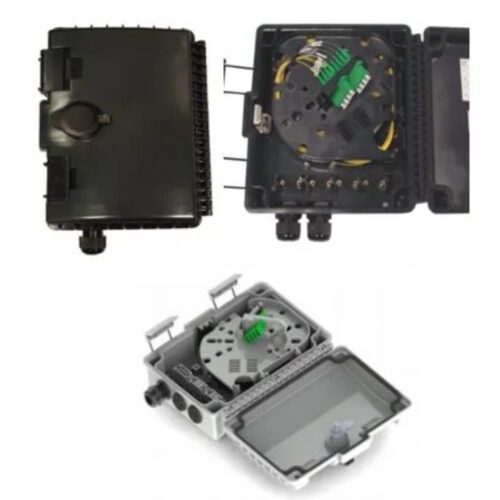
A fiber enclosure, often called a fiber access terminal (FAT) or distribution box, is the sealed box at the edge of an FTTH network where the distribution cable is spliced to the drop cables that run into each home or unit. It holds splice trays, often a small splitter, and adapters so drops can be connected without disturbing the splices.
Where it’s used
- FTTH access points on building walls and poles
- Floor distribution in apartment buildings
- Drop termination for villa clusters
- Small splice and split points in campus networks
Buying advice
How to choose a fiber enclosure.
- 01
Size for future drops
Count the units the box will serve and leave spare ports. Re-entering a full box later to add capacity costs more than the extra ports.
- 02
Check sealing and UV resistance
Boxes on exterior walls and poles in Saudi Arabia sit in direct sun and dust for years. Specify an ingress rating and a UV-stabilised housing suited to outdoor use.
- 03
Match the operator’s design
Most FTTH networks use SC/APC at the access point. Confirm the connector type and splitter ratio against the network design before ordering.
Related services
What is the difference between a FAT and an FDH?
An FDH (fiber distribution hub) is a larger street cabinet that houses the main splitters and serves a whole area. A FAT (fiber access terminal) is a smaller box close to the customer, where the drop cables to individual premises are connected.
Why are FTTH fiber adapters green?
Green marks APC (angled physical contact) connectors, which are polished at 8 degrees to cut back-reflection. APC is the standard for FTTH and video over fiber. Blue marks UPC connectors.
Request a free consultation
Specifying a project?
Tell us about the route, the site or the system. Our engineers will come back with a clear scope and an honest price.