
Indoor Cabinet
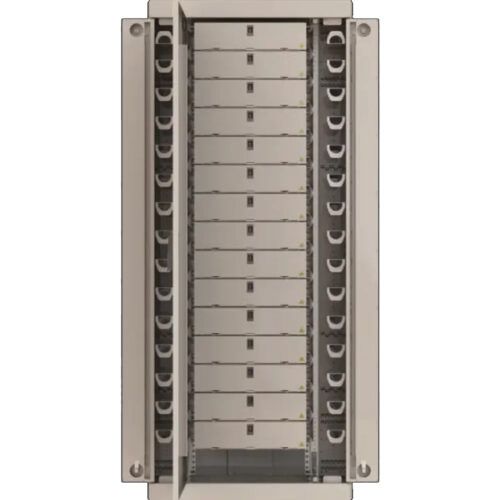
Racks and frames for exchanges, telecom rooms and data rooms, with room for cords to route cleanly.
In short
What is an indoor fiber cabinet?
Indoor fiber cabinets are the racks and frames that hold ODFs, splice shelves and patch panels inside exchanges, data rooms and building telecom rooms. A good one gives every fiber a defined route, keeps patch cords above their minimum bend radius, and leaves room to add capacity without re-cabling.
Where it’s used
- Central offices and exchanges
- Building main distribution and telecom rooms
- Data rooms and server rooms
- Headend rooms for residential compounds
Buying advice
How to choose an indoor cabinet.
- 01
Leave room for patch cords
Most congestion indoors comes from patch cords, not equipment. Choose frames with vertical managers and slack storage sized for the full port count.
- 02
Match the room’s format
Data rooms are usually built around 19-inch racks, while some operator exchanges use ETSI frames. Confirm before ordering so ODFs and shelves fit.
- 03
Plan the access
If the cabinet will stand against a wall, choose equipment that can be installed and maintained entirely from the front.
Related services
What is the difference between a 19-inch rack and an ETSI frame?
19-inch racks have mounting rails 19 inches (482.6 mm) apart and are the standard in data rooms. ETSI frames follow European telecom standards with a 535 mm equipment width and are used in some operator exchanges.
Do I need a cabinet or just a wall box?
A wall-mounted box is enough for a handful of terminations. Once a room has an ODF, active equipment or more than a few dozen fibers, a floor-standing cabinet keeps cabling organised and accessible.
Request a free consultation
Specifying a project?
Tell us about the route, the site or the system. Our engineers will come back with a clear scope and an honest price.