
Patch Cords & Pigtails
Factory-terminated cords and pigtails in SC, LC and FC, APC and UPC, for clean, repeatable connections.
In short
What is the difference between a patch cord and a pigtail?
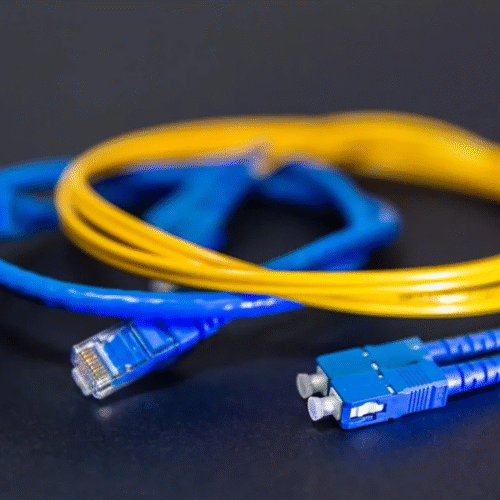
A patch cord is a short fiber cable with connectors on both ends, used to connect equipment and ports. A pigtail has a connector on one end only; its bare end is fusion spliced to a cable fiber inside an ODF, closure or termination box. Both are factory terminated, so their connectors are polished and tested under controlled conditions.
Where it’s used
- Patching between ODF ports and active equipment
- Cross-connects in cabinets and distribution hubs
- Terminating cable fibers inside ODFs and boxes (pigtails)
- Customer-side connections in FTTH
Buying advice
How to choose patch cords.
- 01
Never mix APC and UPC
Mating an APC connector with a UPC one leaves an air gap that causes high loss and can damage both end-faces. Check the polish on both sides of every connection.
- 02
Order lengths that fit
Excess cord ends up coiled in the cabinet, blocking access and airflow. Measure the routes and order standard lengths that suit them.
- 03
Use bend-insensitive cords in dense panels
G.657.A2 cords lose very little when routed around tight corners in crowded patch fields.
Related services
What is the difference between APC and UPC connectors?
UPC connectors are polished flat with a slight dome; APC connectors are polished at an 8-degree angle so reflected light escapes into the cladding. APC gives much lower back-reflection and is the standard for FTTH and RF video, while UPC is common in data and enterprise networks. The two must not be mated.
What is a pigtail used for?
A pigtail turns a spliced cable fiber into a connector. Its bare end is fusion spliced to the incoming fiber, and its connector plugs into an adapter on the ODF or termination box.
Request a free consultation
Specifying a project?
Tell us about the route, the site or the system. Our engineers will come back with a clear scope and an honest price.